Sunday, 24 January 2016


Thursday, 9 February 2012
A statement of intent
Finally, after five years of research I have arrived at a conceptual standpoint from which I feel able to move forwards with making practical work.
This has been a major stumbling block since college because it is important that your work takes on board factual contemporary thought including science, as opposed to inventing things which are obviously not true to the knowledgable or illustrating theory (unless pointing out implausible logic that is your aim of course). Before starting to seek out evidence about what I thought about embodied perception in 2007, I hadn't found a philosophy which I felt made any sense against my own practical experience. My chosen philosophy will now run paralel to my practical work.
Also having been so drawn to dance as a medium, yet not being able to let go of my identity as a painter-come- sculptor collage artist, I have also had to investigate where I am situated in this respect. The opportunity to carry out primary research and talk to the very people working in this area, rather than reading others opinions in books, was made possible by working at Dance UK. It has been valuable, and the six articles that I have now written, have a life of their own as a thesis on collaboration between art and dance, and practitioners who deal with movement in other disciplines. These I hope to publish more widely.
All of this means that I am in fact now at a point where I have established a personal identity, which everything else can be evaluated against, which I needed. All that out of the way I can turn to my practical work again.
In doing this I have realised that something I have always struggled with, is genuine observation of the world around me as a starting point for the work. In other words what to look at. After a four year period of researching as opposed to making, lots of trains of thought have been dropped, leaving just the essential things that fascinate me, that have always fascinated me, which are as follows:
- Changing perspectives in movement and parts of visual language that are related to that- scale, color, light, perspective, line, shape and more recently form.
- Subjects have ranged from journeys, forms that evidence a passage of time/ occurrence of a sequence of events such as rocks/ costal landscapes, and the properties of materials them selves.
- I have a strong interest in process and materials.
Up until now, because of the indecision about where I am coming from creating inertia, it has seemed more important to establish a conceptual clarity around why it is that I feel a truthful representation of my, inhearently spatial, experience in the world, has to be one in which embodied perception and a duration of time are both evident.
It would appear, then, most sensible thing to do next, all things considered, would be to explore some of these things through film amongst other things.
Friday, 16 December 2011
Taking professional dance training was a worthwhile investment
42: 56 in... Anya Gallaccio talking about collaborating with dancers, the difficulties of working collaboratively, and choreographing her audience. A lot of her reservations, for me, stem from not understanding how to communicate with dancers, and possibly not working with dancers who have experience of collaboration outside of dance. Makes me very glad I took the time to do professional training and really understand the job of a dancer and associated thought processes.
Thursday, 15 December 2011
Found an affinity with Lucy Skaer
Lucy Skaer talking about her installation for the turner prize. She is interested in the boundary between 2D and 3D and here she describes how she 'orchestrates' her installations and talks about the idea of 'presence' I wonder how much of that came from her collaborative relationship with Gill Clarke (Siobhan Davies Commissions)? I identify with a lot she says here.
Friday, 9 December 2011
Tate Channel shedding some light on things
I have been listening to the Tate Channel today in my studio. It has been such a relief to listen to artists talking about what they do in practical terms. It made me realise that you just do what you do, it doesn't have to be so complicated!
Jeff Koons, Paula Reago and Grayson Perry were my favourites so far, Grayson Perry: 'Everyone has a brand so I am the tranny potter, which isn't too bad'. Brilliant!
Thursday, 8 December 2011
I have rejoined the Axis community
Axis is a great community of artists and curators, I have just signed up again for another year:
http://www.axisweb.org/seCVPG.aspx?ARTISTID=12243
Tuesday, 6 December 2011
I'd like to know about you
I often wonder who all those people who look at this are.... drop me a line zelda_stevens@hotmail.com
: )
Friday, 2 December 2011
Cognitive wholes, embodied cognition
In the studio today listening to this affirming talk about the cognitive whole that mind and body forms and how this affects learning. The educations system's lack of awareness of this is why my mother chose to teach me at home, and thank god she did!
Although this explains why I have never quite felt on the same page as other people until I met contemporary dancers.
The late Gill Clarke, dance artist and Guy Claxton, learning scientist in conversation as part of The Independent Dance Crossing Borders and PAL talks:
http://www.independentdance.co.uk/rsc/MP3s/CB2011/GuyClaxton_11Oct2011.mp3The bit at 54.35 secs about how we understand perception is enthralling: Guy tells us how the old model of the mind held perception at the fore and action at the back, action as a response to perception with intelligence in the middle. The new model is not linear however, it places doing at the forefront.
He goes onto talk about vision as the prototype for perception, when in fact it is touch.
Visual perception is a visual process of tapping the world. What is more perception is not building up a big composite picture. In fact you only have the detail, which enables you to build up expectations of the world, built by touching it.
Thursday, 1 December 2011
Artist statement
It is four years since I started this blog and the new lines of enquiry that are now starting to take shape. To pin things down and move them forwards i have written an artist statement:
I make room filling installations, objects and drawings (drawing spanning traditional media/dance/assemblage). Between 2004- 2008, I extended my painting practice driven by my increasing realisation of the role of the body in perception. Because my experience of the world is highly sensory, visual and crucially mobile, I felt my work couldn't continue to serve the eyes alone. It remains important that the form of my work encourages spatial participation from the viewer.
In deconstructing painting I increased the scale of the work to encompass the viewer entirely and extended the work into their territory, requiring them to interact with the it on spatial terms. The architectural boundaries of the space replaced the 2D frame as a compositional device, and the work was constructed of painting materials. This work was often site-specific, always responsive to the exhibition space and sometimes related visually to the space outside the gallery/site. It was largely informed by the experience of moving through urban landscapes.
Having made this departure, since 2008 I have increasingly explored ideas relating to movement and by extension, natural forces: balance, tension/oppositional forces, exertion of force on a material of space, rhythm and energy. The work is informed by physical practices including contemporary dance/movement and direct observation of humans in movement and natural forms and forces.
Influences include Phylida Barlow, modernist painter Peter Lanyon (master of articulating sensory, mobile, landscape experiences) and contemporary choreographer Siobhan Davies, a pioneer of the body as a source of information for making visual art.
Thursday, 17 November 2011
Siobhan Davies pays tribute to Gill Clarke
Siobhan Davies today made this statement about Gill on the facebook page of Siobhan Davies Dance:
She was simply a really fine person and I have lost a great friend who knew me well. I shall miss her terribly but her understanding was that we would all have a little of her within us and she hoped that we would evolve and in different ways carry that part of her along. She was typically modest imagining it was only a small part, I know how much of her is embedded in me and that will continuously give me energy and questions.
Gill loved dance with an intelligent passion. She intuitively appreciated that there is a knowing in our bodies that too often we are not in touch with. Her lifelong work as a performer, teacher and researcher was to reveal the mindful intelligence of the moving body and what that means to all of us as people, our relationship with others and our place in the world.
She is irreplaceable, but she prepared us all. Fiona Millward at Independent Dance will continue with its extraordinary program and there are many others in place who will carry on and grow through Gill's spirit and enquiries.'
- Siobhan Davies
RIP Gill Clarke
I am deeply saddened to hear that the dance world has lost one of its greatest souls, a great artist and one of its most interesting thinkers about what it is to move in a body.
Independent Dance, of which Gill was Director has issued the following message today:
Gill Clarke died on November 15 2011 as she lived, calmly and with great poise.
ID has lost a wonderful director and inspiring artist. However, we have been working together to ensure our vision of ID continues to grow.
We have already been receiving some beautiful messages and this has given us the idea to create a place where we can hold them, and to consider appropriate ways to share them.
So, if you would like to send thoughts, memories, or images of Gill, please email them to: gillclarke@independentdance.co.uk
Here she is, doing what she does best, may those who knew her and her work grow the seeds that she planted:
Mind in Motion by Gill Clarke from HZT Berlin on Vimeo.
Friday, 4 November 2011
Alexis investigates, article five: A conversation with Siobhan Davies about dance thinking

Recently choreographer Siobhan Davies has seemingly turned curator, commissioning four new collaborations between dancers and visual artists, the results of which are being shown in an exhibition titled Siobhan Davies Commissions, running from the 4 –13 November at Bargehouse, London (www.siobhandavies.com/dance/dance-works/sdc.html).
This will be the third major show in visual arts territory from Siobhan Davies Dance following The Collection at Victoria Miro Gallery and IKON Gallery Birmingham in 2009, and ROTOR at Siobhan Davies Studios and South London Gallery in 2010 (touring in 2011 to Whitworth Gallery in Manchester and Dovecot Studios in Edinburgh). Of the four commissioned dance artists, Henry Montes, Gill Clarke, and Sarah Warsop are partnered respectively with video and performance artist Marcus Coates, Turner Prize-nominated Lucy Skaer, and craft artist Tracey Rowledge. The fourth, Deborah Saxon, is working with Henry Montes and Bruce Sharp, who works in video, sound and drawing.
As both visual artist and dance maker, I was interested to know why cross art form dialogue has become such a key part of Siobhan’s artistic output. We met for an hour one crisp October morning in Siobhan’s glass fronted office in South London. I talked with Siobhan about how curating had become an extension of her own choreographic trajectory, why collaboration is important to her and how all of this relates to her personal campaign to promote dance thinking as a generator for ideas in other art forms. Talking with at times her eyes shut, hands floating back and forth, Siobhan gently uncovered the words to give me an insight that I share with you here.
So what does happen when a choreographer is situated in the role of curator? Read the full article here: www.danceuk.org/news/article/alexis-investigates-article-five-conversation-siobhan-davies-about-dance-thinking
This is the fifth in a series of articles that I have written about art and dance having a dialogue. Read the rest here: www.danceuk.org/news/article/artist-alexis-zelda-stevens-writes-series-articles-dance-uk-about-art-and-dance/
Thursday, 20 October 2011
Invited to write about Siobhan Davies' new commissions
On Tuesday I went down to see Siobhan to talk to her about her recent commissions where she becomes more curator than choreographer. Her team have invited me to write abou the work and I am looking forward to talking to some of the dance artists involved next week.
Of the four commissioned dance artists, Henry Montes, Gill Clarke, and Sarah Warsop are partnered respectively with video and performance artist Marcus Coates, Turner Prize-nominated Lucy Skaer, and craft artist Tracey Rowledge. The fourth, Deborah Saxon, is working with Henry Montes and Bruce Sharp, who works in video, sound and drawing.
Siobhan Davies Commissions continues Davies’ approach of creating work to be seen at close range, and based on a dialogue between art forms. All of the pieces, including performance works, are on show for five hours daily, and visitors are free to arrive and leave as they please.
Siobhan Davies Commissions will be open from 4–13 November 2001 at Bargehouse, London
www.siobhandavies.com/dance/dance-works/sdc.html
Friday, 30 September 2011
They say your brain shows you a memory rather that what your eyes really see

As soon as my pencil touches the paper things come spilling out, my voice wants to speak.
But to say something new, feels like I have to stop my eyes from seeing what they always see and look further.
It feels like I am pulling it out of the dark, trying to see round what I know which is obscuring everything.
Thursday, 26 May 2011
Monday, 28 March 2011
The pile of drawings is growing


Things are starting to come together with the new body of work.
New images uploaded today:
Friday, 18 March 2011
New series of drawings in the making

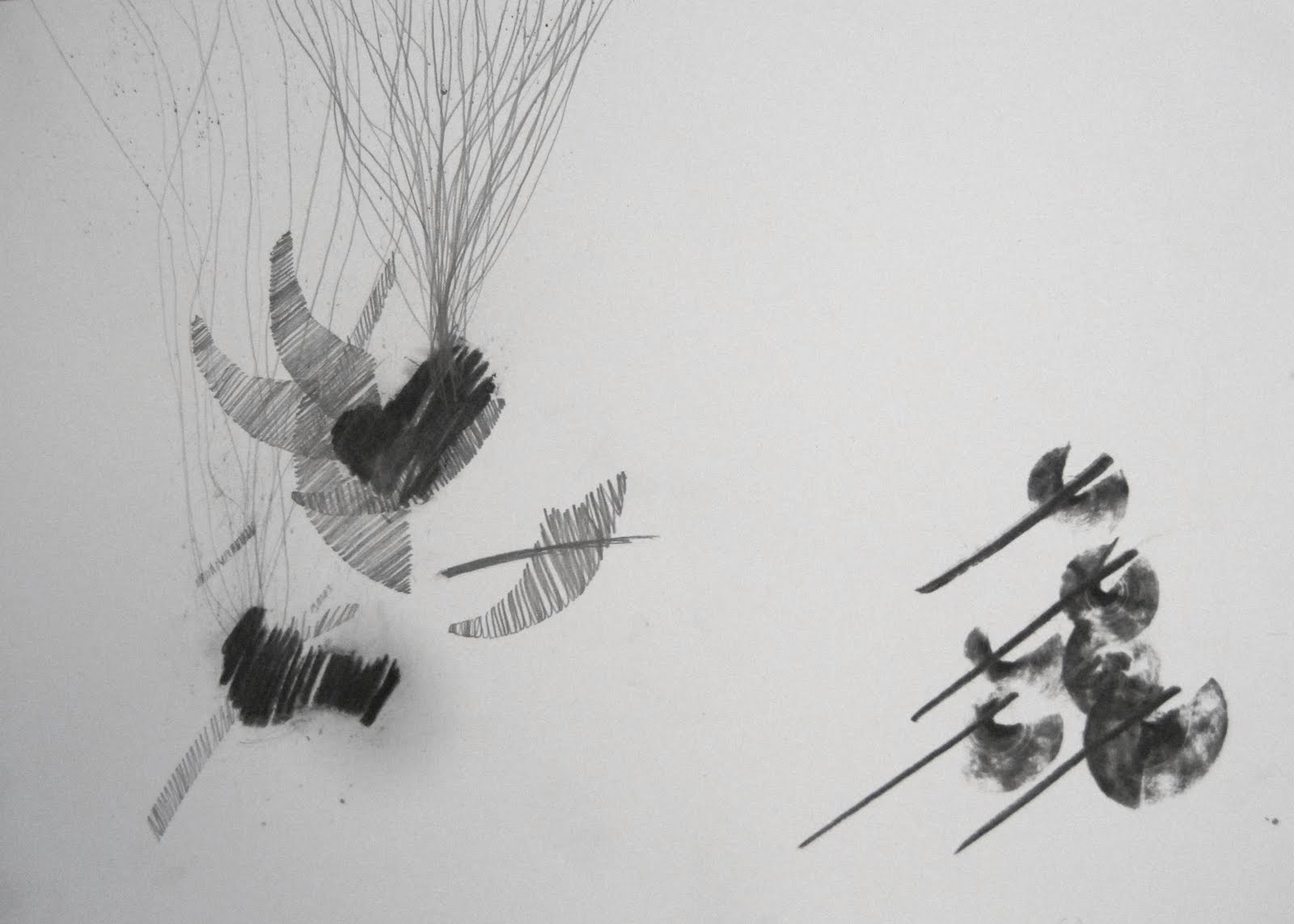
I have been in the studio every Friday since the beginning of March, making a new series of drawings.
They explore the movement patterns, forms and shapes of crowds converging and dispersing.
I have decided to give all of my blog followers a sneak preview here:
Do forgive the picture quality, work in progress : )
More 'Alexis Investigates dance and visual arts' Article four: Catching movement, painter Peter Lanyon now live on Dance UK website

Here is an excerpt:
I first came across Peter Lanyon's paintings over ten years ago. At the time I had a conundrum, I was looking at a career in the visual arts but my natural affinity was with moving in the world, not looking at it. My only arena for this was ballet and I was awful at it, my teacher often having to disguise her horror at my imprecise joy in throwing myself around. There were no release based contemporary dance classes on the Isle of Wight where I had grown up or things may have been different. I spent a lot of time outdoors on the beach and I wanted to paint how it felt to physically be in landscape, rather than what it looked like viewed from a fixed point. Lanyon did just that and I felt such an affinity with him that at 18, I made a decision. I moved 300 miles away from home to experience what he had, paint what he had, and immerse myself in his homeland, Cornwall. I was subsequently reffered to by critic Max Andrews in New York Arts Magazine as part of the St.Ives New School (read the article here). Tate St. Ives has recently held a restrospective of Lanyon's work called Peter Lanyon, which ran from October 2010 to the end of January 2011.
Read the full article on the Dance UK website here:
www.a-n.co.uk/artists_talking/projects/single/797558/0/1/asc
Picture credit: Peter Lanyon 1918-1964 'Wreck' 1963 Oil on canvas 122 x 183 cm Tate © Estate of Peter Lanyon. All Rights Reserved, DACS 2010
Saturday, 12 March 2011
Siobhan Davies article re post request from Jade
I have recently been contacted by Jade regarding the article
Alexis Investigates: Dance and Visual Arts. Article One: A Visit to Siobhan Davies Dance Company.
This article is not available online, at www.danceuk.org/news/article/alexis-investigates-dance-and-visual-arts-article-one-visit-siobhan-davies-dance-company/
It was temporarily offline due to a data transfer error .
Apologies to all those of you who have been trying to access it, all back to normal now.
Tuesday, 14 December 2010
Yvonne Rainer and my divorce from painting
The Big Intensive has been mind shaking so far. Words about that are on the way, in the meantime, Dance UK, the national voice for the dance sector, have published my third article about visual arts and dance.
Here is an excerpt from the article, titled Falling in Love With Another Artform, Yvonne Rainer and My Divorce From Painting:
'As an artist with integrity, you have to be prepared to follow your line of enquiry to the end wherever it may take you. This very situation stared me in the face three years ago, and it was heartbreaking to realise that my love affair with painting was over. After basing my identity, and whole world around striving to be the next great painter, I had fallen for another art form - dance. What is more I wasn’t trained in it and I was 25. However, as anyone who has fallen out of love will know, you just can’t ignore that pull of something that makes you feel life is meaningful again, offering you possibility to move forwards. So in 2008 I shut the studio door, leotard in hand and ran away with dance.
Yvonne Rainer similarly moved from dance to film. She was co-founder of The Judson Church during 1960’s in New York, where she first became intrigued by the relationship between the performer and audience, the political and the private in everyday life. In the 1960’s she rocked the conventions of the dance world, introducing pedestrian movement and using people as props. Her works were task based and looked to the uneducated eye, like someone doing Ballet badly.'
All the three articles and the introductory text that goes with them are collected here on my Artists' Newsletter project blog:
Subscribe to:
Posts (Atom)